Equipment guides
Boom Lift vs Scissor Lift: Which Aerial Platform Do You Need?
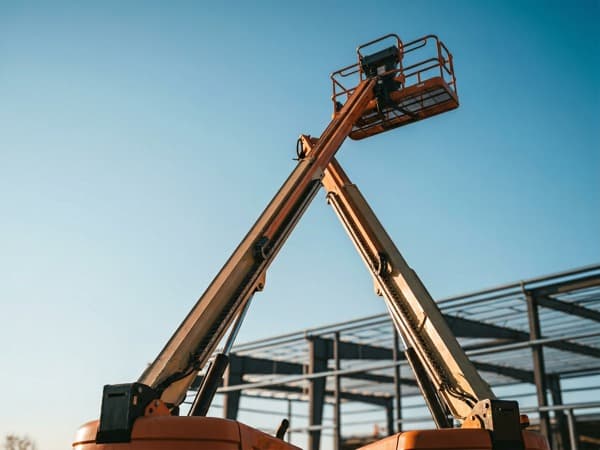
Both lift you up, but they solve different problems. A scissor lift goes straight up; a boom lift reaches up and over. Here is how to choose between them.
Choose a scissor lift for broad, repetitive work at a steady height — ceilings, walls, racking, signage — where a large, stable deck and higher capacity matter. Choose a boom lift when you need to reach up and over an obstacle to a precise point a scissor lift cannot get to. Both get a worker off the ground; the deciding question is whether you move straight up, or up, out and over. Picking the wrong one means either a platform that cannot reach where you need it, or paying for capability you do not use.
The core difference: straight up vs up and over
A scissor lift raises a platform vertically on a folding, cross-braced mechanism. You get a large, stable work deck and good lifting capacity, but the movement is straight up and down. It is the tool for working across a broad area at a steady height — ceilings, walls, racking, signage.
A boom lift puts the platform on an articulating or telescopic arm. That arm reaches up, out, and often over obstacles to place the operator at a precise point. Where a scissor lift cannot get past a barrier or into a corner, a boom can.
Match the lift to the work
Think about how you need to reach the work, not just how high it is.
| Scissor lift | Boom lift | |
|---|---|---|
| Movement | Vertical only | Up, out and over |
| Platform | Large deck, higher capacity | Smaller basket, one or two people |
| Best for | Broad work at a set height | Reaching awkward or obstructed points |
| Footprint | Compact, drives between bays | Needs room to position the arm |
Indoor or outdoor decides the power and chassis
The second question is the environment. Electric scissor and boom lifts run clean and compact for indoor work on flat floors. Rough-terrain diesel models, on wider tyres or four-wheel drive, handle uneven outdoor ground but are not for inside use. Confirm floor loading and ground conditions before choosing — a heavy rough-terrain machine can damage a finished surface.
A quick decision checklist
- Do you need to reach over or around an obstacle? Boom lift.
- Is it broad, repetitive work at a steady height? Scissor lift.
- Indoors on a finished floor? Electric model.
- Outdoors on rough ground? Rough-terrain diesel.
- How many people and how much equipment on the platform? That sets the capacity.
Rent the right platform per job
Few sites need the same lift every week, which makes aerial platforms a classic rental category — you match the exact machine to each task instead of owning a mixed fleet. For the cost trade-off between renting, leasing and owning, see rent, lease or finance equipment, and compare your figures in the rent vs lease vs buy calculator.
Frequently asked questions
- What is the difference between a boom lift and a scissor lift?
- A scissor lift raises a platform straight up on a crossed-beam mechanism, giving a large work deck but vertical movement only. A boom lift raises a platform on a hinged or telescopic arm, so it can reach up and outward, over obstacles, to a precise point. Scissor lifts suit broad work at height; boom lifts suit positioning into awkward spots.
- Can you use a boom lift or scissor lift indoors?
- Yes, with the right model. Electric scissor lifts and electric boom lifts are made for indoor use on flat, firm floors — no emissions and a compact footprint. Rough-terrain diesel models are for outdoor work on uneven ground and should not be used inside.
- Which is safer or more stable, a boom or a scissor lift?
- Both are safe when used within their rated limits. Scissor lifts have a wide, stable base and a large platform, which suits steady work. Boom lifts put the operator on an extended arm, so wind, reach and load limits matter more — but they reach places a scissor lift cannot. Match the machine to the task rather than ranking one as universally safer.
Sources & further reading
About the author
Equiply Editorial TeamEquipment Finance Editorial Team
The Equiply editorial team covers industrial and maritime equipment access — rental, leasing and financing — for procurement and finance leaders across Europe.
Compare your options on Equiply
Equiply brings rental, leasing and financing for industrial and maritime equipment into one place. Be first to access the marketplace.