Equipment guides
Generator Sizing Guide: What kVA Do You Need?
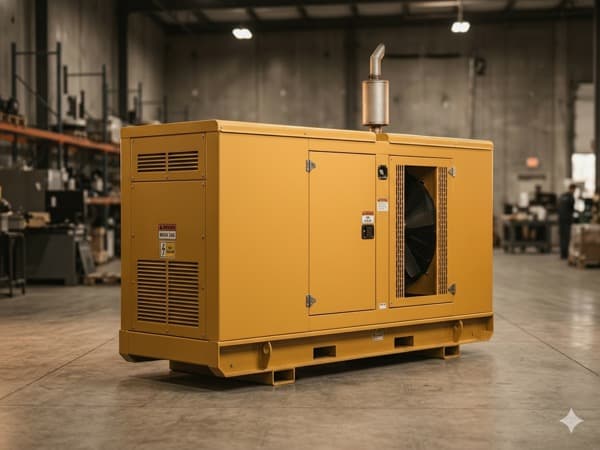
Pick a generator that is too small and it trips; too big and you waste fuel and money. Sizing comes down to your running load, starting surges and a sensible margin.
A generator that is undersized trips out under load or struggles to start motors; one that is wildly oversized burns fuel inefficiently and costs more than it needs to. To size one, add up the running power of everything it must supply, convert to kVA using the power factor, add the largest motor's starting surge, then add 20-25% headroom and pick the next standard rating above that figure. The calculation rests on three things: what you are running, what it takes to start, and a sensible safety margin.
Step 1: add up the running load
List every device the generator must power and note its running power. Convert the total to kVA using the power factor — generators are rated in kVA because that is the apparent power they actually have to deliver, not just the useful kW. For a typical mixed site load the power factor sits around 0.8, so kVA is a bit higher than the kW total.
This running total is the floor, not the answer. Most jobs need more because of how equipment starts.
Step 2: allow for starting surges
Motors — pumps, compressors, lifts — draw far more current at the moment they start than when they run, sometimes several times their running figure. If everything could start at once, the generator has to cope with that peak without stalling.
Identify the largest motor and add its starting surge on top of the running total. If multiple large motors can start together, account for that. This step is where motor-heavy sites end up needing a noticeably bigger machine than the steady-state numbers imply.
Step 3: add headroom
Finish with a margin — commonly around 20-25% — for safety, voltage stability, and any load you might add later. That cushion keeps the generator off its limit, where efficiency and reliability both suffer.
The sizing in short
- Sum the running power of all loads.
- Convert to kVA using the power factor.
- Add the largest motor's starting surge.
- Add ~20-25% headroom.
- Choose the next standard generator rating above that figure.
Avoid oversizing too
Bigger is not automatically safer. A large generator running lightly loaded wastes fuel and risks wet stacking, where unburnt fuel builds up in the engine. Aim to match the rating to real demand plus reasonable headroom — not to buy the biggest unit available.
Rent the size the job needs
Power demand changes from site to site and season to season, which makes generators a strong rental fit — you bring in the exact kVA each job needs rather than owning one compromise unit. For the cost trade-off between renting, leasing and owning, see rent, lease or finance equipment, and model your own numbers in the rent vs lease vs buy calculator.
Frequently asked questions
- How do I calculate what size generator I need?
- Add up the running power of everything the generator must supply, convert to kVA using the power factor, then add the largest motor's starting surge and a headroom margin of around 20-25%. The result is the minimum continuous rating you need. Motor-heavy loads usually drive the size up more than the steady running total suggests.
- What is the difference between kW and kVA?
- kW is the real power that does useful work; kVA is the apparent power the generator must actually supply. They are linked by the power factor (kW = kVA × power factor). Generators are rated in kVA because they have to handle the apparent power, which for typical mixed loads runs at a power factor around 0.8.
- Is it bad to oversize a generator?
- Yes, within reason. A heavily oversized generator running on a light load wastes fuel and can suffer wet stacking, where unburnt fuel fouls the engine. Some headroom is healthy for surges and future load, but matching the rating to the real demand keeps it efficient and reliable.
Sources & further reading
About the author
Equiply Editorial TeamEquipment Finance Editorial Team
The Equiply editorial team covers industrial and maritime equipment access — rental, leasing and financing — for procurement and finance leaders across Europe.
Compare your options on Equiply
Equiply brings rental, leasing and financing for industrial and maritime equipment into one place. Be first to access the marketplace.