Equipment guides
Telehandler Guide: Choosing the Right Machine
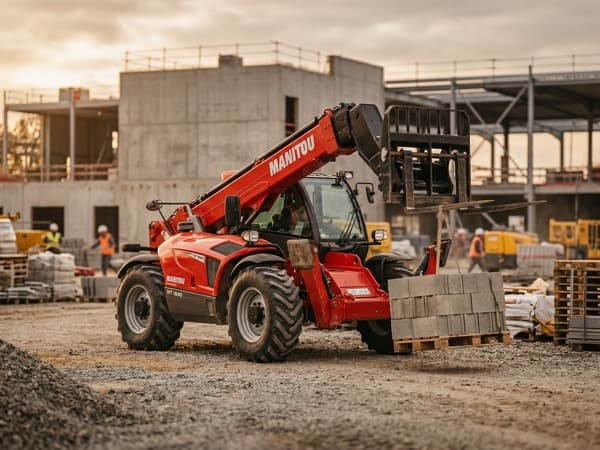
A telehandler is the Swiss-army machine of a site: lift, reach and place loads where a forklift or crane cannot. Choosing one comes down to height, capacity and reach.
Few machines earn their keep on a site like a telehandler. With a telescopic boom and interchangeable attachments it lifts pallets to height, reaches over obstacles, loads materials and doubles as a work platform. Choosing one comes down to three numbers — maximum lift height, maximum capacity, and above all capacity at full reach — because a telehandler is defined by what it can lift with the boom extended, not by its headline figure.
The three numbers that matter
Every telehandler decision turns on three figures:
- Maximum lift height — how high the boom reaches at full extension.
- Maximum capacity — the heaviest load it can lift, close to the machine.
- Capacity at full reach — what it can lift with the boom extended out and up.
The third is the one people miss. A machine rated at 4 tonnes maximum might handle only 1 tonne at the end of a fully extended boom. Because telehandlers exist to place loads at distance, capacity at reach usually decides whether a machine fits the job. Always read the load chart at the height and reach you will actually work at.
Attachments change the machine
The standard fork carriage makes a telehandler a reach forklift, but the attachment options widen its role: buckets for loose material, lifting hooks and jibs for slinging loads, work platforms for access, and sweepers or grabs for specialist tasks. If you need more than basic forking, check that the machine supports the attachment and that capacity is rated for it.
Terrain and site fit
Most telehandlers are built for rough ground, but size and turning circle still matter. A compact model manoeuvres inside tight builds and low structures; a large high-reach machine needs room and firm ground. Match the chassis to where it will work, and confirm ground-bearing capacity for the heaviest lifts.
A specification checklist
- Heaviest load and the height and reach it must go to
- Capacity at that reach (from the load chart, not the maximum)
- Attachments you need and their rated capacity
- Site access, turning space and ground conditions
Rent the reach you need, when you need it
Because telehandler demand swings with the task — a compact unit for one job, a high-reach machine for another — they are a natural rental category. Owning one workhorse and renting the rest avoids paying for capability that sits idle. For the cost trade-off between renting, leasing and owning, see rent, lease or finance equipment, and compare your figures in the rent vs lease vs buy calculator.
Frequently asked questions
- What is a telehandler used for?
- A telehandler, or telescopic handler, is a machine with an extending boom that lifts and places loads at height and at distance. With a fork carriage it works like a reach-capable forklift; swap attachments and it becomes a bucket loader, a work platform or a lifting hook. It bridges the gap between a forklift and a small crane.
- How do I choose telehandler capacity and lift height?
- Start with the heaviest load and the highest and furthest point you need to place it. The key figure is capacity at full reach, not the headline maximum — a telehandler that lifts 4 tonnes close in may only manage 1 tonne at full boom extension. Read the load chart at your actual working reach and height.
- Should I rent or buy a telehandler?
- Rent when your need is project-based or seasonal, or when you want a reach or capacity you do not normally run. Buying suits a core machine used most weeks across many jobs. Many contractors own one general-purpose telehandler and rent larger or specialist models when a specific task demands them.
Sources & further reading
About the author
Equiply Editorial TeamEquipment Finance Editorial Team
The Equiply editorial team covers industrial and maritime equipment access — rental, leasing and financing — for procurement and finance leaders across Europe.
Compare your options on Equiply
Equiply brings rental, leasing and financing for industrial and maritime equipment into one place. Be first to access the marketplace.