Equipment guides
Types of Aerial Work Platforms Explained
Scissor lifts, boom lifts, mast lifts, spider lifts and truck-mounted platforms each suit a different job. Here is what separates them and when to pick each one.
Choosing the wrong aerial work platform wastes a hire day and can stop a job entirely. A machine that cannot reach over a parked truck, or a diesel boom that you cannot run inside a warehouse, is money parked on site doing nothing. The category names overlap and the spec sheets blur together, so this guide breaks down the main types, the work each one suits, and whether it belongs indoors, outdoors, or both.
1. Scissor lifts
Scissor lifts raise a wide platform vertically on a folding crossed-brace mechanism. They give you a big, stable working area and good load capacity, which makes them the default for jobs directly overhead: ceiling services, ductwork, racking installs, painting and signage. Electric scissor lifts with non-marking tyres work indoors on flat slabs. Diesel rough-terrain versions handle uneven ground and slopes outdoors. If you are weighing this against an angled reach, read boom lift vs scissor lift before you book.
2. Articulating boom lifts
Articulating, or knuckle, booms have multiple jointed sections that bend around obstacles. That up-and-over reach is what you pay for: working above a fixed machine, accessing the underside of a structure, or getting to a façade you cannot park directly beneath. Compact electric articulating booms suit indoor maintenance in plants and arenas. Larger diesel and bi-energy units cover outdoor construction and steelwork. They need clear ground space to set the chassis and slew the boom.
3. Telescopic boom lifts
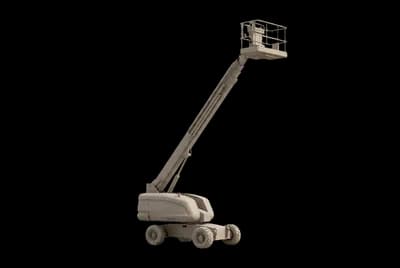
Telescopic, or stick, booms extend in a straight line to deliver the longest horizontal and vertical reach of any MEWP. Use them where you need to throw a platform a long way across a site, over water, or across an obstruction that a scissor lift cannot bridge: bridge work, large outdoor structures, tank and silo access. Most are diesel or bi-energy and built for outdoor, firm-ground use. Set-up footprint and outrigger or counterweight requirements matter here.
4. Vertical and personnel mast lifts
Mast lifts raise a single operator, sometimes with light tools, straight up on a compact column. They are narrow, lightweight and easy to push through doorways and into lifts, which makes them ideal for stock-picking, retail fit-out, light maintenance and tasks in tight corridors. Almost all are electric and built for indoor use on flat floors. They trade reach and capacity for manoeuvrability, so they are wrong for heavy or multi-person work.
5. Push-around and spider lifts
Push-around platforms are very light vertical lifts moved by hand and locked off before use, suited to short indoor tasks like changing lights or signage. Spider, or tracked, lifts fold to a narrow width to pass through standard doorways, then deploy outriggers to give boom-level reach from a tiny footprint. Spider lifts shine on jobs a vehicle cannot reach: courtyards, churches, atriums, soft ground and roof terraces. Many are bi-energy, so they run on battery indoors and on a combustion engine outdoors.
6. Truck-mounted platforms
Truck-mounted platforms bolt a telescopic or articulating boom onto a road-going vehicle. The operator drives between sites, sets outriggers and works without a separate transport hire. They are the standard for spread-out outdoor jobs with frequent moves: street lighting, signage, tree work, telecoms and façade inspection. The trade-off is that the truck needs road access and stable ground for the outriggers, so they are outdoor-only equipment.
How to access an aerial work platform
For a one-off job or a short campaign, renting is usually the cheapest and simplest route, and it puts the maintenance burden on the supplier. If a platform is core to your operation and runs most weeks of the year, leasing or financing can lower the cost per working hour and keep a known machine on site. The split depends on your utilisation and how the cost lands on your balance sheet. Run your real numbers through the rent vs lease vs buy calculator before you commit, and confirm operators hold a current platform certificate for the category you choose.
Frequently asked questions
- What is the difference between a scissor lift and a boom lift?
- A scissor lift moves straight up and down on a stable platform and is best for work directly overhead. A boom lift extends up and outwards, so it can reach over obstacles and work at an angle. Boom lifts cost more and need more space to set up.
- Which aerial work platforms can I use indoors?
- Electric scissor lifts, vertical mast lifts and compact electric articulating booms are designed for indoor use because they leave no fumes and have non-marking tyres. Diesel rough-terrain machines and most truck-mounted platforms are outdoor equipment.
- Do operators need a licence to use a MEWP in Europe?
- Operators must be trained and competent for the category of platform they use. Many European employers require an IPAF PAL Card or an equivalent recognised certificate, plus familiarisation on the specific machine before work starts.
Sources & further reading
About the author
Equiply Editorial TeamEquipment Finance Editorial Team
The Equiply editorial team covers industrial and maritime equipment access — rental, leasing and financing — for procurement and finance leaders across Europe.
Compare your options on Equiply
Equiply brings rental, leasing and financing for industrial and maritime equipment into one place. Be first to access the marketplace.