Equipment guides
Forklift Types and How to Choose
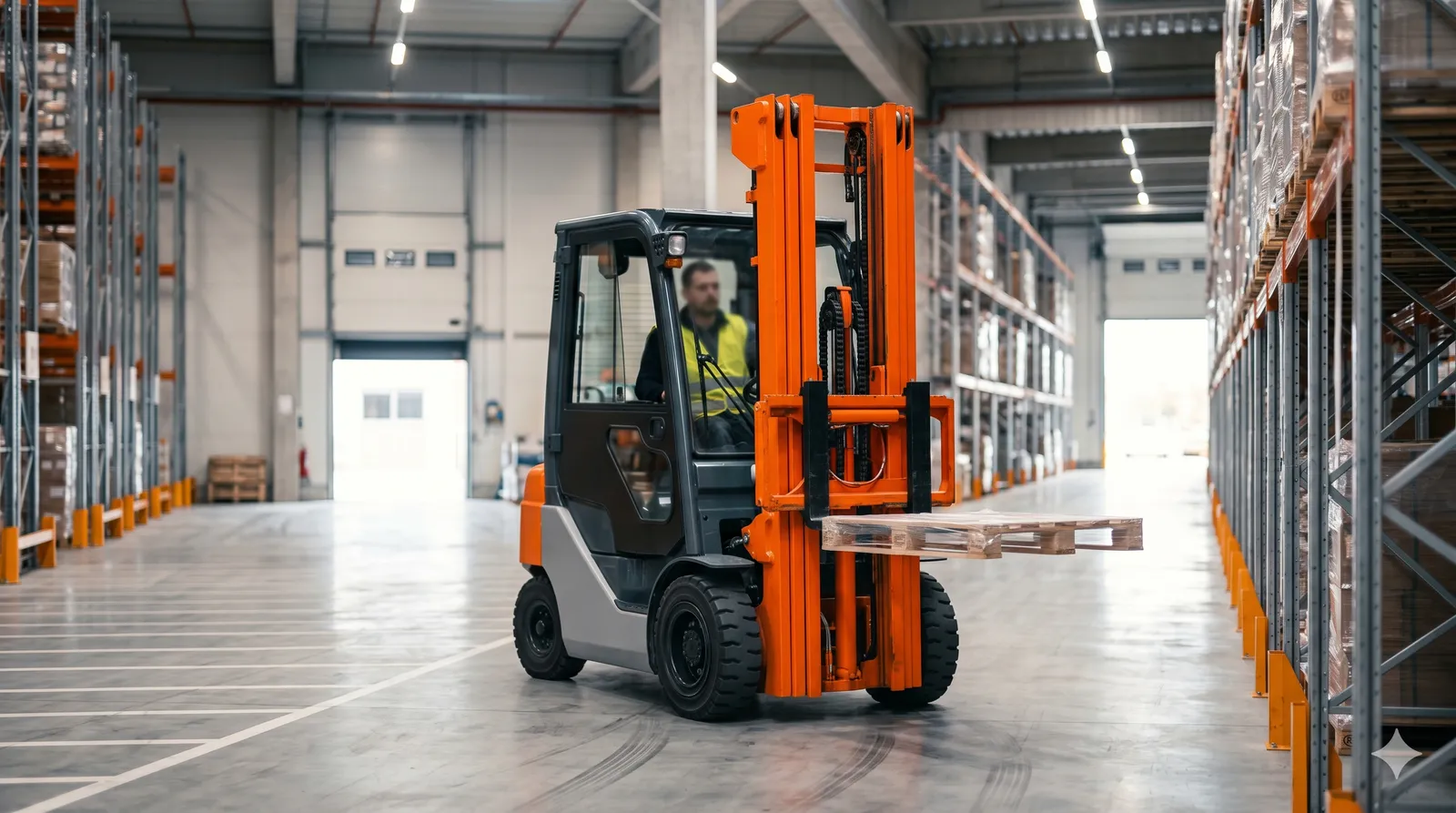
Counterbalance, reach truck, rough-terrain, telehandler, pallet truck and container handler all move loads, but they are built for different sites. Here is how to pick.
The right forklift is set by where it works, not by capacity alone: a counterbalance truck for general yard and warehouse loading, a reach truck for narrow-aisle racking, a rough-terrain forklift for unsurfaced sites, a telehandler for lifting at height and reach, a pallet truck or pedestrian stacker for short ground-level moves, and a container handler or reach stacker for ports. A forklift that cannot turn in your aisle, lift to your top rack, or run safely indoors is the wrong machine, no matter how good the price looked — the choice depends on where it works, how high it stacks, the floor it runs on, and the fuel you can support.
1. Counterbalance forklift
The counterbalance is the machine most people picture. Forks sit at the front and a built-in counterweight at the rear keeps it stable, so it drives straight up to a load with no outriggers. It handles general loading, yard work, container loading and warehouse moves. Electric counterbalance trucks suit indoor and mixed work; diesel models cover heavy outdoor duty; LPG runs in both with ventilation. It needs wide aisles, which costs floor space in a tight warehouse.
2. Reach truck
A reach truck is built for narrow-aisle warehouse racking. Its forks extend forward on a moving carriage to place pallets deep into racking, and the mast lifts far higher than a counterbalance, which lets you stack more vertically and waste less floor. These are electric machines designed for flat indoor slabs. They are not for outdoor or uneven ground, so a reach truck and a yard machine often work in tandem.
3. Rough-terrain forklift
Rough-terrain forklifts have large pneumatic tyres, high ground clearance and often four-wheel drive, so they move loads across mud, gravel and uneven sites. They are the standard for construction yards, timber yards, agriculture and any unsurfaced ground. Almost all run on diesel for the power and endurance outdoor work demands. They are too large and fume-producing for indoor use, so keep them on the yard.
4. Telehandler
A telehandler combines a forklift's lifting with a telescopic boom, so it reaches up and out to place loads at height and distance on rough ground. That makes it a workhorse on construction sites, where one machine loads, stacks and places materials a fixed-mast truck cannot reach. Most are diesel. They are versatile but bigger and pricier than a plain forklift, so size them to the job. For a full breakdown of capacities and attachments, see the telehandler guide.
5. Pallet truck and pedestrian stacker
Pallet trucks and pedestrian stackers are the lightest tier: an operator walks behind or rides along to move pallets short distances at low height. They are cheap, compact and ideal for loading bays, retail back-of-house, order picking and short internal transport. Powered versions are electric and made for indoor flat floors. They cannot lift to racking height or carry heavy outdoor loads, so they complement rather than replace a counterbalance.
6. Container handler and reach stacker
Container handlers and reach stackers are the heavy end, built to lift and stack shipping containers in ports and intermodal yards. A reach stacker can stack containers several high and reach across rows, which gives a port far more flexibility than a fixed crane for the same footprint. These are large diesel machines for outdoor, hard-standing use only. If you are weighing one against a forklift for unit loads, read reach stacker vs forklift.
How to access the right forklift
Match the machine to the work first, then decide how to pay for it. For seasonal peaks, project work or a fleet you are still right-sizing, renting keeps you flexible and shifts maintenance to the supplier. For a forklift that runs daily, year-round, leasing or financing usually lowers the cost per hour and lets you spec the exact machine and fuel your site supports. Put your hours and duty cycle through the rent vs lease vs buy calculator to see which route is cheapest for your real usage.
Frequently asked questions
- Should I choose an electric, diesel or LPG forklift?
- Electric forklifts suit indoor and clean-air work and have lower running costs, but need charging and battery management. Diesel forklifts give the most power and runtime for heavy outdoor use. LPG sits between the two and can run indoors with ventilation, which makes it a flexible choice for mixed sites.
- What is the difference between a reach truck and a counterbalance forklift?
- A counterbalance forklift carries the load in front and uses rear weight to stay stable, so it needs wide aisles but works anywhere. A reach truck extends its forks forward into racking, so it works in narrow aisles and reaches higher, but it is built for smooth indoor floors only.
- When should I use a telehandler instead of a forklift?
- Use a telehandler when you need to place loads at height or distance on rough ground, such as on a construction site. A standard forklift is better for level yards and warehouse floors where you mainly move pallets short distances.
Sources & further reading
About the author
Equiply Editorial TeamEquipment Finance Editorial Team
The Equiply editorial team covers industrial and maritime equipment access — rental, leasing and financing — for procurement and finance leaders across Europe.
Compare your options on Equiply
Equiply brings rental, leasing and financing for industrial and maritime equipment into one place. Be first to access the marketplace.